
The Science Behind Natural Wool Insulation
At a time when the construction industry is under pressure to decarbonise and prioritise healthy indoor environments. Truewool is proving that the solution might just lie in one of Wales’ oldest resources: wool.
We caught up with Mair from Truewool to find out more about the innovation, sustainability and future vision behind their natural insulation product.
Innovation & Product Development
What inspired the creation of Truewool insulation?
Truewool began with a simple yet powerful commitment. To transform Wales’ abundant natural resource, wool, into sustainable insulation solutions. The goal was to create a material that is natural, hygroscopic, safe to handle (with no eye, skin, or lung irritation), and fully recyclable at the end of its life. Avoiding the need for landfill and championing circular economy principles were key motivators right from the start.
How has your approach to R&D shaped the product we see today?
It was a significant challenge to find a manufacturing process that didn’t incorporate plastics to enhance durability. While adding plastics could have improved product durability and cost-effectiveness. It would have compromised our commitment to full circularity and biodegradability. The team pushed through these hurdles because they understood the long-term importance of reducing plastic use and its associated environmental and health risks.
Environmental Impact
How does Truewool compare to synthetic insulation in terms of carbon footprint?
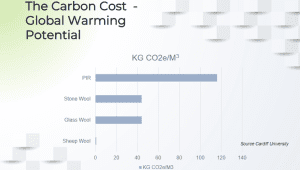
Truewool has a fraction of the embodied carbon associated with synthetic insulation materials. In a 2020 review of low-carbon building materials conducted by Cardiff University. Sheep’s wool was compared against more common insulation materials – and the results were clear. Wool stands out as a low-carbon option that supports the broader goal of reaching net zero.
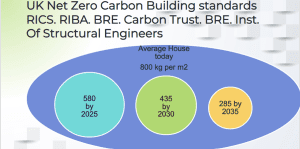
The scale of the challenge for Net Zero is overwhelming, below is an illustration of the amount of carbon per m² in a property and how much we need to reduce in order to reach net zero, materials that are low in embodied carbon play an integral part in this journey.
As the construction industry faces the huge challenge of reducing carbon emissions. Using materials with low embodied carbon – like wool – will play a vital role in this transition.
 |
 |
Industry & Future Development
How do you see the natural insulation market evolving over the next 5–10 years?
On our route to net zero we have to decarbonise our built environment, reduce the operational and embodied carbon emissions. We also need to improve the health and wellbeing of building occupants by selecting better materials – especially in new builds and retrofit projects. There is also the need for using smarter materials that can handle moisture to minimise the risk of damp, mould and condensation. Wool can play an important role in this function as it does not support the growth of mould or mildew.
What’s next for Truewool—are there new products or applications on the horizon?
We’re expanding into blown-in wool insulation for modern methods of construction and cavity wall applications. Testing is currently in the final stages for this product in conjunction with Smart funding from Welsh Government.
What advice would you give to builders or homeowners considering switching to wool insulation?
Feedback we receive from clients is how pleasant the material is to handle. And for many contractors they are struggling to find loft installers and so providing a material that is not an eye, skin or lung irritant means they attract more people into the role helping to close the skills gap shortage for decarbonisation. It is also welcomed by follow on trades that will need to visit the loft space over the years for maintenance tasks.
Are there specific sectors that are embracing Truewool more than others?
Yes – particularly in the traditional building and heritage sector. Hygroscopic, bio-based materials like wool are recognised as the least risk-based approach to retrofit in moisture-sensitive buildings. We have around 1/3 of housing stock in Wales that is solid wall construction built pre 1919 and these are all classed as traditional housing stock regardless of listed status and therefore require careful consideration of materials used during retrofit to maintain breathability, avoid unintended consequences like damp, mould and condensation and protect the asset value.
Brecon’s Watton Mount project that was filmed and broadcasted by Ffermio is an excellent example. Whereby all of the original timbers had to be retained in a grade II Listed building and in order to do this they needed to ensure that insulative materials introduced had to be hygroscopic, open vapour an fully breathable and so Truewool was specified by Rio Architects at the design stage.
Indoor air quality and purification is also a key driver to customers selecting Truewool. People are starting to understand the impact of poor air quality on health and wellbeing. And also the need to avoid introducing products that contain formaldehyde or other volatile organic compounds (VOCs). Truewool excels at air purification and has been proved to absorb VOC’s in our indoor air and chemically bind them to its structure, permanently removing them from the atmosphere.